
A century ago, doctors described a disease in retired boxers. The name they gave it was blunt: punch-drunk syndrome. Memory starts to leak. Temper slips its leash. Movement slows. It ends in dementia. A hundred years on, the condition has a formal name, chronic traumatic encephalopathy, or CTE. But one thing had not changed in all that time: the only way to confirm that someone actually had it was to wait until they died and open up their brain.
Over the past week, two papers in the Journal of the American Medical Association have made that look like it might finally change. Two unrelated research groups found the same signal in blood. What follows is not written to make you excited, and it is not written to frighten you. It is written to take the story apart and pull out the piece that actually concerns your child.
Start with what the disease really is, because this is the part most coverage skips. Inside a neuron there is a structure called the microtubule network: part scaffolding, part railway for moving material around. A protein called tau has one normal job, which is holding those rails in place. After repeated blows to the head, tau comes loose, changes shape, sticks to itself, and ends up as insoluble tangles. Wherever the tangles pile up, neurons die and tissue shrinks. The part worth noticing is where they pile up. Tau in CTE is not spread evenly. It crowds into the deepest point of the cortical folds, hugging the small blood vessels that run there. That location is not arbitrary. When the brain moves inside the skull, mechanical shear concentrates at exactly those fold bottoms and around those vessels. Put another way, the pattern of the damage preserves the physics of the original impacts. It is also what separates this disease from Alzheimer's under a microscope.
On the left, CTE: tau tangles crowd into the deepest point of the cortical folds, hugging the small blood vessels found there. On the right, Alzheimer’s: the same protein, spread far more diffusely. The CTE location is not arbitrary. It is where mechanical shear concentrates when the brain moves inside the skull, so the pathology preserves the physics of the original impacts. Schematic, not to scale.
Drawn from the CTE neuropathology literature (perivascular p-tau at sulcal depths is the signature CTE lesion)
The discovery itself was close to an accident. A team at Washington University School of Medicine in St. Louis was working on Alzheimer's, with 229 samples drawn from several biorepositories. While screening a blood marker, they found one sample with an unusually high reading, except the person did not have Alzheimer's. They pulled his autopsy record. He had advanced CTE. So they widened the search, worked with the University of California, San Francisco, and tested blood from 11 more people whose CTE had been confirmed at autopsy. The readings were higher than in healthy people, and the more advanced the disease, the higher the reading. Dr. Chihiro Sato, a co-senior author, called it “just a matter of serendipity.”
The thing they found is called eMTBR-tau243. The name comes apart easily enough. MTBR is the microtubule-binding region of the tau protein, and 243 is the position of that fragment along the amino acid chain. What matters is this: once tau has formed insoluble tangles, this short piece breaks off the aggregate and leaks into body fluid. So its presence in blood is an indirect report on how many tangles are in the brain. The hard part is measuring it. Dr. Nicholas Ashton, one of the study authors, put the difficulty this way: “Imagine taking a sugar cube, breaking it into 200 pieces, throwing one of those pieces into an Olympic-sized swimming pool and then finding it in 15 minutes. There are a lot of failures until you get one right.”
The second paper comes from the CTE Research Center at Boston University together with Banner Health, with more than two dozen researchers involved. They had 21 former football players who had donated blood while alive and their brains after death. The autopsies found CTE in 18 of them, 16 at an advanced stage. Of the 21, twelve had played professionally, seven at college level, and two only in high school. The blood matched the autopsy: men with advanced CTE had high concentrations of the protein in plasma, while those with early-stage disease had very little or none. Dr. Michael Alosco, a senior author, described it plainly: “When we looked at the data, we saw that there was a very clear separation with almost no overlap in the data points between those with high-stage C.T.E. and everyone else.”
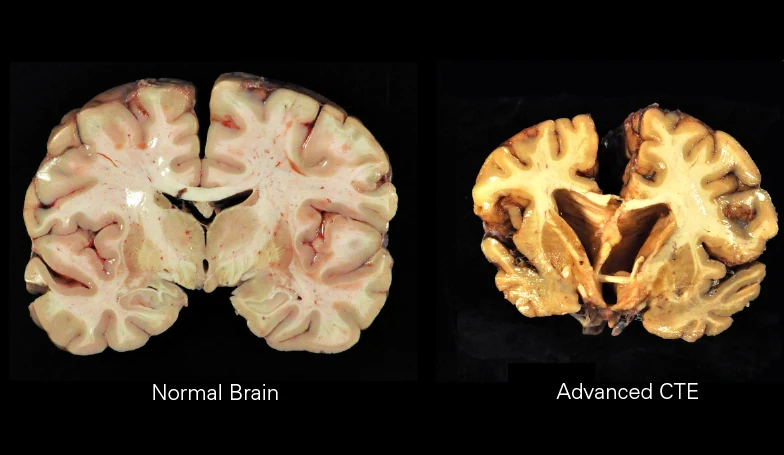
Where the tangles end up. The dark cavity in the middle of the brain on the right is the ventricle. It looks enormous not because it grew, but because the tissue around it is gone. This image comes from the Boston University centre that produced the second of the two studies described here.
Image: Boston University Center for the Study of Traumatic Encephalopathy, CC BY-SA 4.0
Now the limits, taken more seriously than a headline takes them. First, the samples are 11 people and 21 people. Those are very small numbers, and the findings have to wait on larger ones. Second, the marker cannot detect early CTE. It only climbs clearly in advanced disease, and early is precisely when knowing would be worth most. Third, and most fundamental: it cannot tell CTE and Alzheimer's apart. The reason sits in the mechanism itself. Tau tangles in both diseases are the mixed 3R/4R type, and the only reason this marker can see CTE at all is that it was built to see Alzheimer's. Its power and its weakness are the same fact. Sato said so herself before anyone else could: “This is not going to be a standalone biomarker.” Marc Weisskopf, who directs epidemiological studies at the Football Players Health Study at Harvard, was blunter: for now this is at best a research tool. The authors hope for a commercial test within five years, and the technology has been licensed to a company that already sells an Alzheimer's blood test. That is a reasonable expectation. It is not a promise.
Here is the part that frightens parents most and misleads them most: the percentages. A study published in October found that about 74.5% of NFL players who died between 2008 and 2023 had CTE. It is worth looking at how that number was made. The researchers had 387 players who had donated their brains, and 362 of them (94%) showed CTE pathology. But donors are not a random sample. A player who had cognitive symptoms while alive was roughly five times more likely to have his brain donated than one who did not. The researchers used exactly that ratio to adjust 94% downward to 74.5%. An earlier paper from the same group, covering 2016 to 2021, reported a range of 25% to 98%, a width honest enough to be uncomfortable. And at the other end: among donors to ordinary community brain banks, CTE turns up in under 1%. Ninety-four percent, 74.5%, 25 to 98%, under 1%. Four numbers, one disease, none of them lying, and all of them meaning different things. The disease is real, and it is heavily concentrated in a particular exposed population. It is not ambient in the air.
So how much of what happened to those football players transfers to your child? What transfers is one word: dose. A 2020 study in Annals of Neurology analysed 266 deceased football players and found that each additional year of play raised the odds of CTE by about 30%, which works out to roughly a doubling every 2.6 years. Notice the shape of that sentence. It is not about whether someone ever suffered one serious concussion. It is about how many impacts accumulated in total. In fact a substantial share of CTE cases were never diagnosed with a concussion while alive. The work is being done by the thousands of small collisions that nobody thought twice about at the time.
Each additional year of play raises the odds by about 30%, which works out to roughly a doubling every 2.6 years. The horizontal axis is years played; the vertical axis is relative odds. Note carefully that these are relative odds, not absolute risk. The claim is not that ten years means you will get it, but that each increment of exposure moves the odds up proportionally. The sample is a brain bank, not a random population, and some players with careers over fifteen years had no CTE. But the direction is clear, and the direction is the part a parent can use.
Data: Mez et al., Annals of Neurology 2020;87:116–131. 266 deceased football players; odds ratio 1.30 per year played (95% CI 1.19–1.41)
There is one more finding that gets quoted constantly and quoted wrongly. A 2018 study of 211 people with confirmed CTE found that those who began playing tackle football before age 12 developed cognitive symptoms about 13 years earlier on average. You will see that sentence everywhere. But the original paper contains two more findings that almost never travel with it. Age of first exposure did not predict how severe the pathology was. And the same pattern showed up in former players who did not have CTE. So the defensible reading is not “starting younger makes CTE more likely.” It is “repeated head impacts in childhood erode the brain's reserve for coping with damage later.” Those two sentences sound similar and mean very different things. The second one holds up better, and it is the one worth remembering.
Many parents reading this will be thinking that American football has nothing to do with them. That is true. But the mechanism described above has nothing to do with the sport. It has to do with one thing only: repeated impact to the head. So the list that actually applies is heading in football, boxing, sanda, taekwondo, wrestling, and rugby and ice hockey at international schools. The English Football Association banned heading in training for under-12s from 2020; US Soccer bans it at ten and under. Worth adding: these specific age thresholds have not been rigorously validated in the peer-reviewed literature. They are reasonable precaution, not settled science. Knowing that is better than either adopting them blindly or dismissing them blindly.
So what is this actually good for? First, it is not grounds for keeping a child out of sport. The evidence does not support that conclusion, and what sport gives a child is real. What the logic of dose points to is three dials you can turn: the age at which contact play begins, the total number of years played, and how many real impacts there are in a week of practice. That last one is the most underrated and the easiest to change, because most impacts happen in training, not in games. A study of players aged 9 to 12 found that restricting contact work to a third of total practice time cut head contacts by 37%. A high school intervention that combined limits on full-contact practice with dedicated tackling-technique training cut concussion risk during practice by 82%. None of that was bought by pulling children out. It was bought by practising the same sport differently. The counterexample is worth remembering too: when the NCAA eliminated two-a-day practices, head impacts did not fall, and when preseason contact days rose in 2017, total impact burden went up 26%. Rules work when they actually reduce the number of impacts. Moving the calendar around does nothing.
Finally, back to that vial of blood. If it holds up, it changes more than diagnosis. It turns one sentence, “we will know after he is gone,” into another, “we can look at a number now.” For a family, the distance between those two sentences is not a technical distance. It is the difference between being able to make a decision and not. But that is still years away, and it may not arrive at all. Until then, what a parent actually holds is not a test. It is that word: dose. How old your child was when they started, how many years they have played, how many real impacts there are in a week. None of those three requires anyone’s permission. You can start managing them this season.
Reader discussion
You have read it. What do you make of it?
Loading…